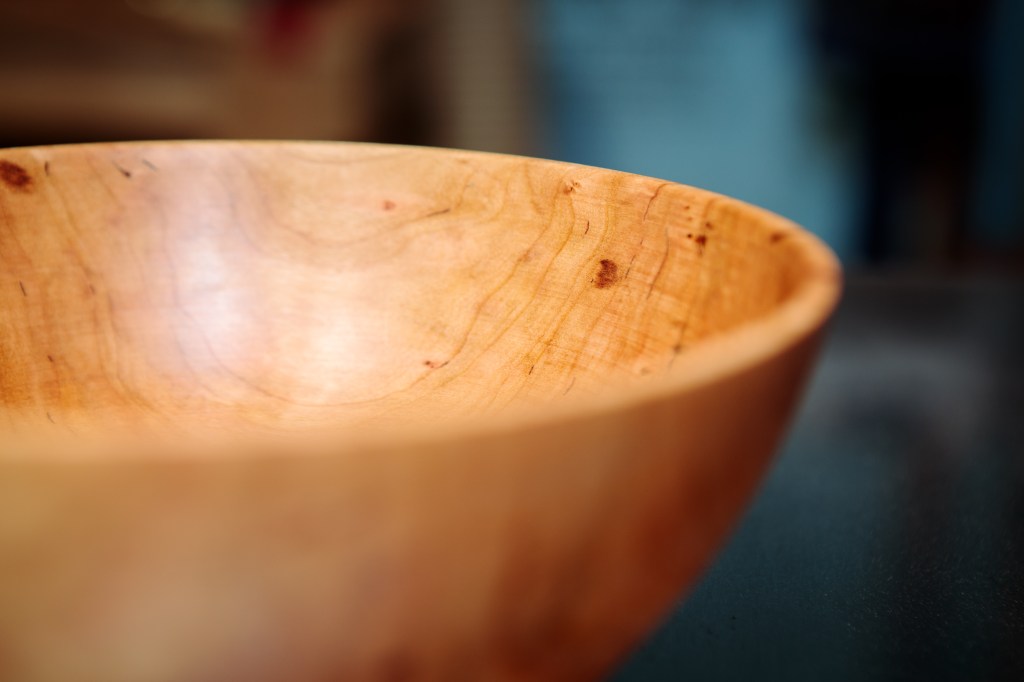
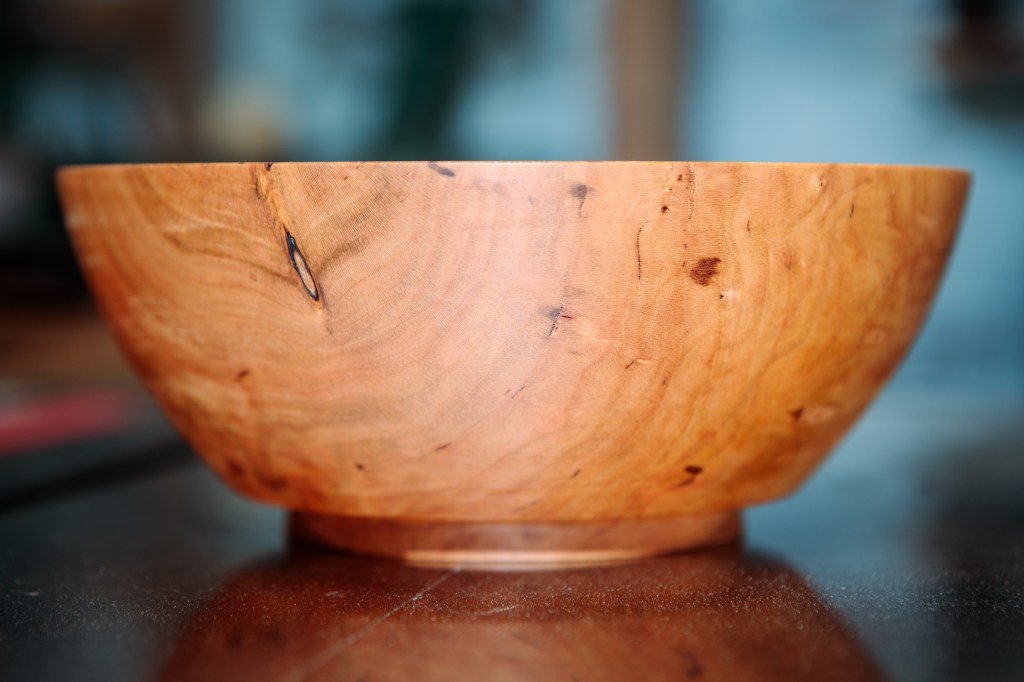
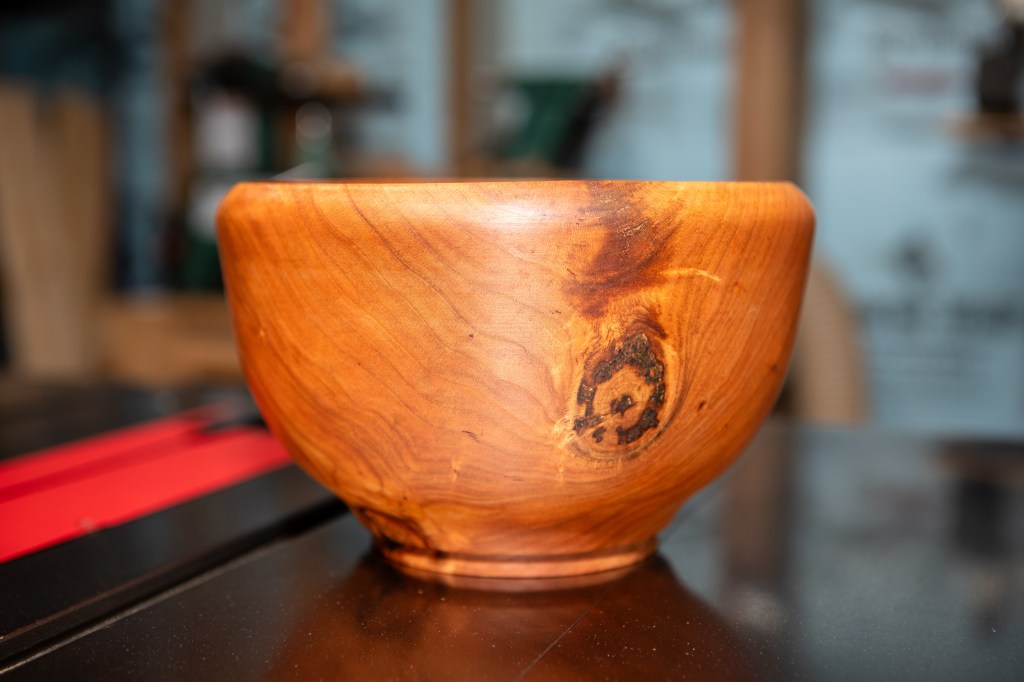
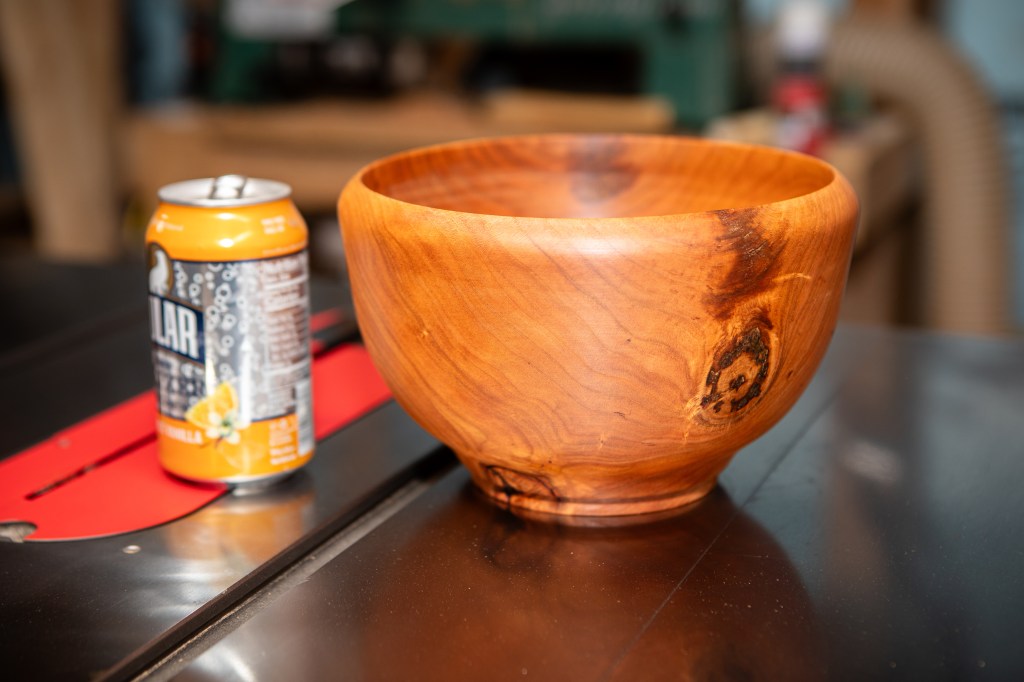
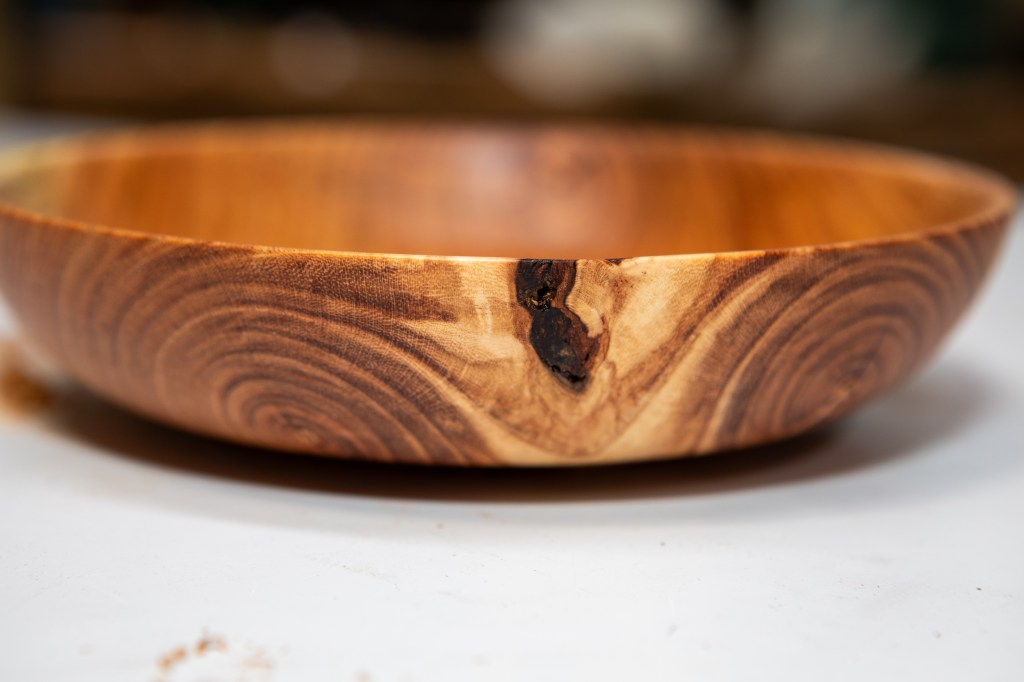
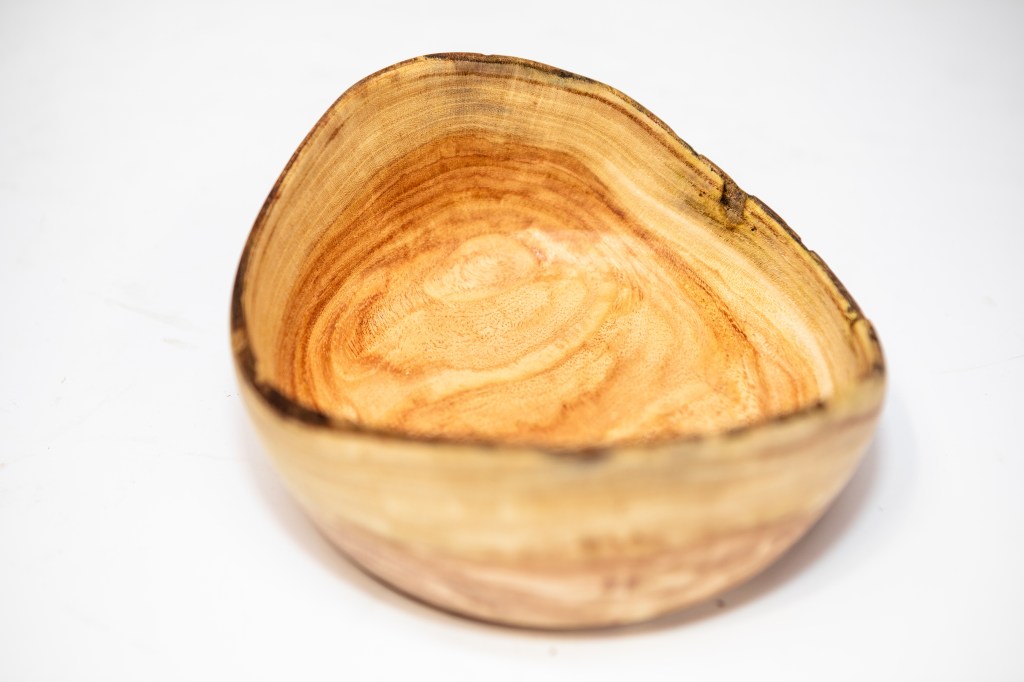
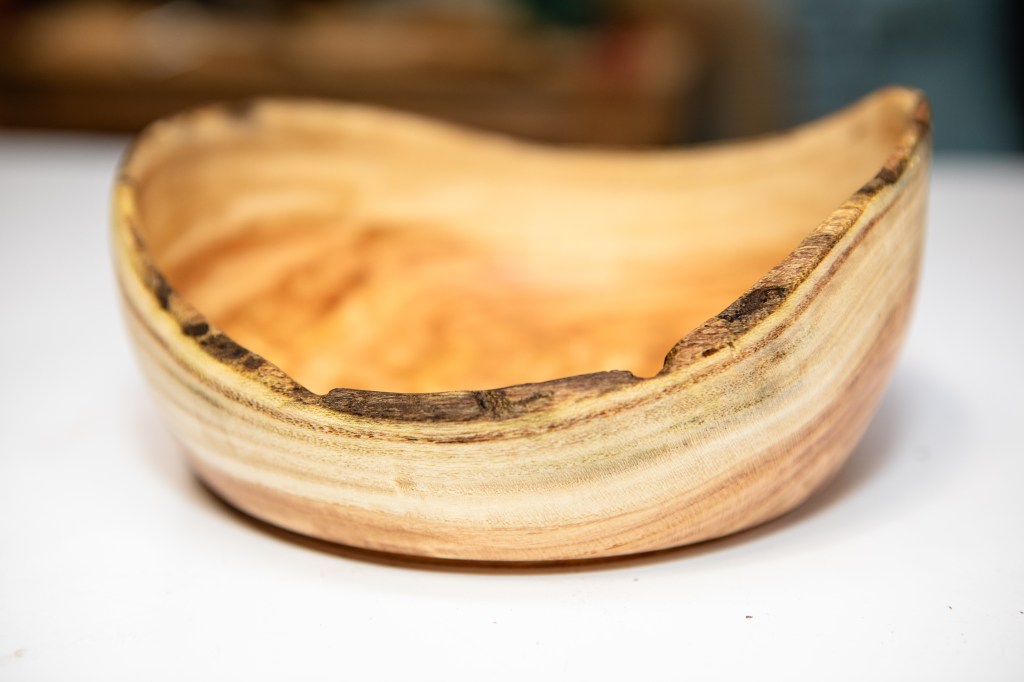
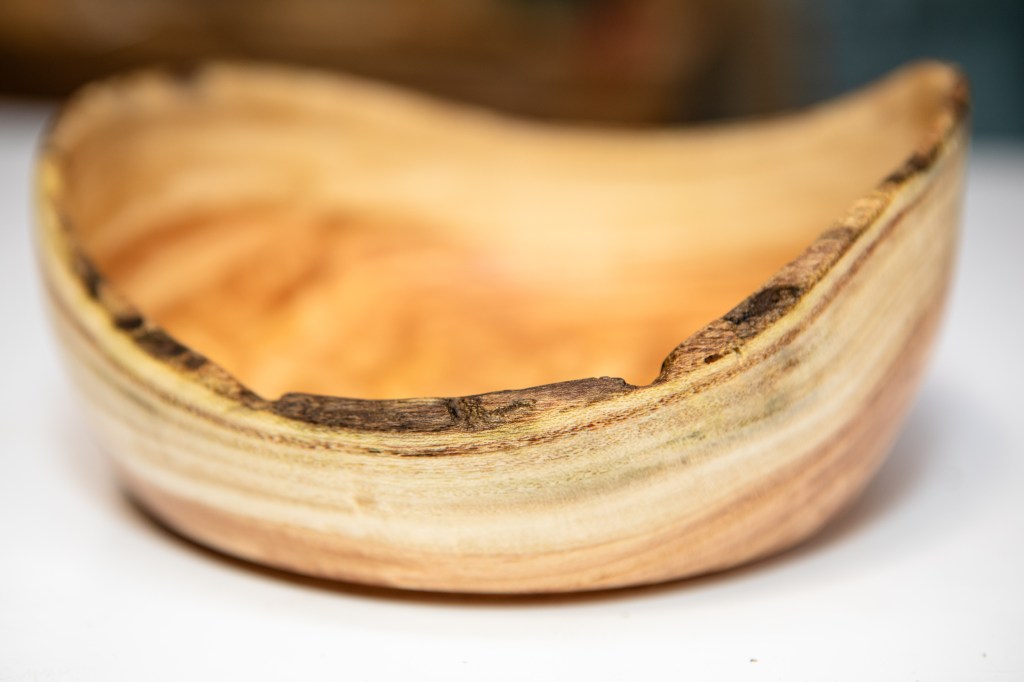
I rough turned this Cherry bowl several months ago and it has been drying in my basement since. I didn’t have high expectations for the finished bowl because it just looked a bit plain.
Happily, this turned about to be incorrect – it has far more visual interest than I expected.
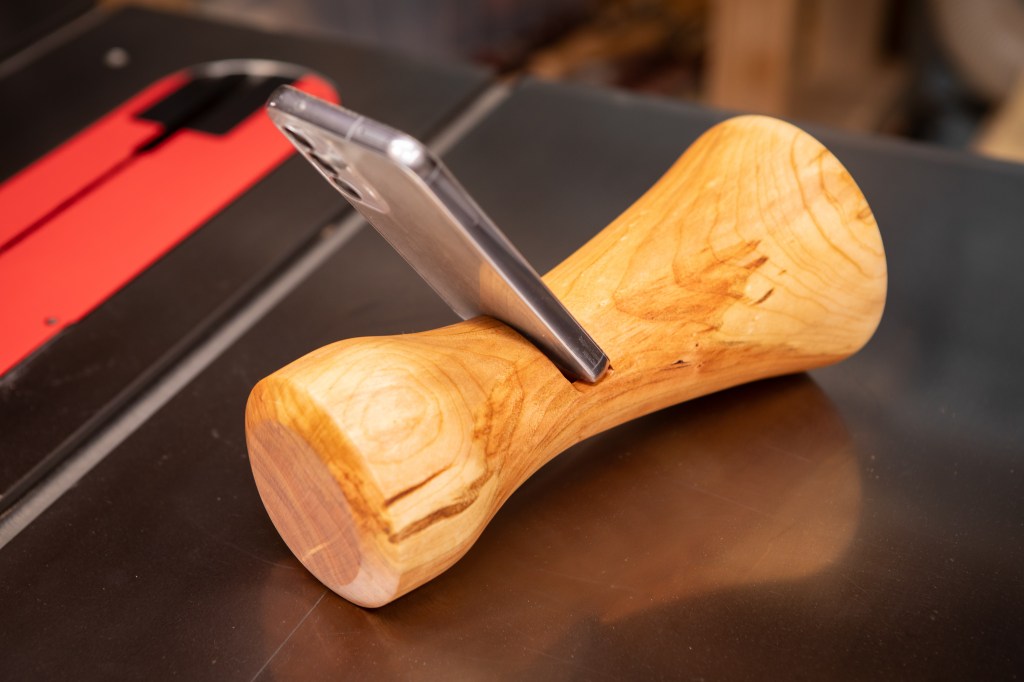
A friend sent a video to me a couple of days ago, showing someone making a “passive speaker” on the lathe – one of those horns (for lack of a better term) you place your phone into to amplify the sound.
I’ve had a piece of Cherry sitting on my shelf for a couple of years now for which I just haven’t had the right project. This seemed like a great use.
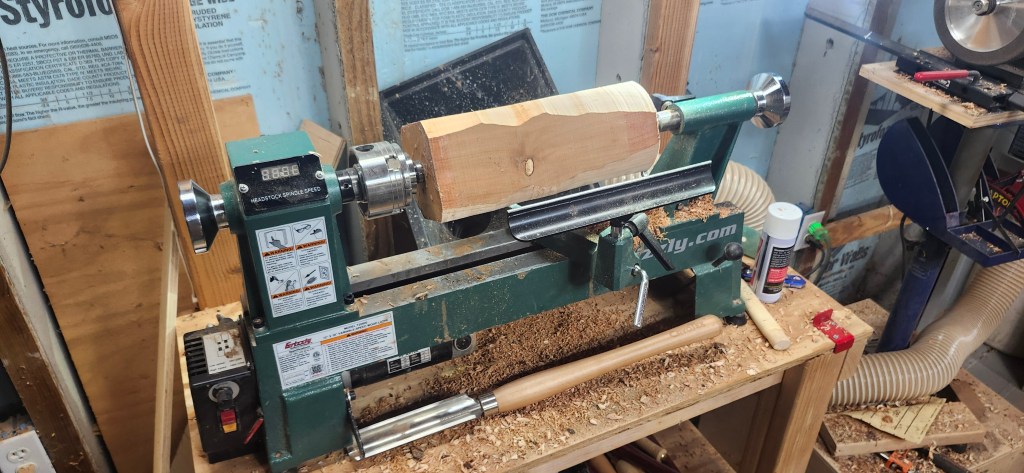
I started off with this piece, maybe 6″x6″.
After 3.5 frustrating hours Wednesday night, I completed the shape – inside and out. It was an incredibly frustrating experience on my lathe, trying to hollow out the horn into end-grain, when the piece was this long and I don’t have any support other than this small chuck.
The next step, after work on Thursday, was the nerve-wracking step of taking a saw to this nicely shaped horn! It isn’t perfectly symmetrical, but is close enough.
It’s starting to actually look like a thing!
The last piece was to flatten the bottom of the rear portion so it doesn’t roll. I adhered a sheet of sandpaper to some plywood and quickly ground down a flat bottom. Nice and stable.
The best part, finishing, was done with a 1:1 mixture of pure Tung Oil and citrus solvent. I’ve applied one coat so far, and it’s looking great. Sounds pretty good too!
Over the weekend I finally turned one of the Cherry wood blanks that has been drying in my basement for over 2 years now. The blank was on the larger side, and I didn’t want to waste a bunch of the wood, so I decided to try a taller bowl than usual.
I think I found the limit, height-wise, of a piece like this on my lathe. It just caused too many vibrations and too many tool marks. To top it off, there were plenty of knots and soft-ish spots inside.
I recently turned a small Elm bowl/dish. The knots and cracks were a little bit of a challenge to deal with. I wanted to keep them in the final result so I filled them with dark brown CA glue.
Two weeks ago I moved my main antenna from my front yard to the first floor roof – above my garage. I was skeptical of how well it was going to work, but tried it anyway, screen and all.
The results were positive – that little antenna continued to do great for DX on 10 meters and the new position provided an improvement for the local 2 meter and 70cm nets. I was sold!
It just didn’t look great with a mag mount antenna, sitting off kilter on the roof.
Two days ago I ordered 75′ of coax and it was delivered today. As I sat at my desk after work, poking around on FT-8, I couldn’t resist the urge to see how it would do on the SECOND story roof. Longtime followers may remember many years ago I had a wifi antenna up on the (fake) chimney column, so I’ve been itching to see what this antenna would do up there. 30 minutes and a nervous climb later, the mag mount was happily resting on the chimney column. (No photos, I didn’t take my phone up with me).
The real test came later tonight when I tuned into the local ARES Simplex net – one I’ve historically struggled with. I’m usually hear a fraction of the operators, and only a handful hear me.
Not tonight! All but one was crystal clear and many reported hearing me very well. YES!
So now the research will begin for a more permanent antenna, but this one will do for a little while! You know what they say about permanent temporary solutions… 🙂
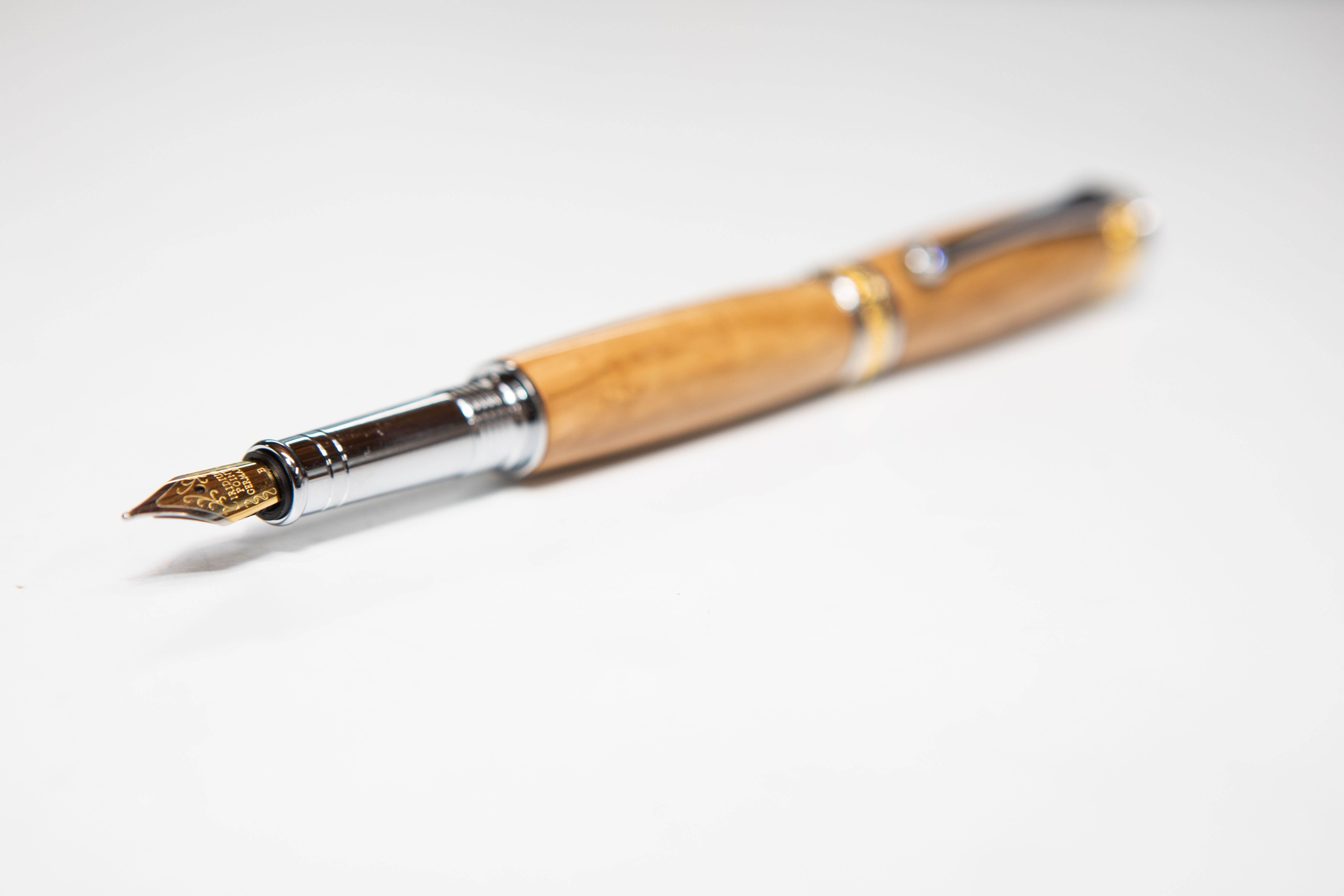
I was finally able to order the remaining part for this Majestic fountain pen kit. I’ve yet to write with one of these myself, but they sure do look great.
I recently completed my first fountain pen, a Majestic Junior model from Penn State Industries. The wood is a piece of white oak from the Shawshank Tree, the tree at the end of the movie The Shawshank Redemption.
It has worked very well except for one major annoyance. Wind noise above 60mph. As soon as I go over 60, the high-pitched whistling gets louder and louder. After 6 hours in the car last weekend, I just couldn’t stand it anymore. The thought of highway speeds for an extended period of time makes me want to take the antenna off.
After noticing the stock antenna’s spiraling wire running its length, followed by some googling, I learned that that is a common way to avoid the noise I’m experiencing. I saw a few forum posts about DIY’ing it with string and heat-shrink tubing. So that’s what I set out to do this morning.
The first step was to disassemble the antenna so I could get the small segment wrapped, capturing the distance between segments before taking them apart.
Next was to spiral some nylon string around this small segment. Keeping the string in place was tricky until I pulled out the hot glue gun and tacked it into place.
Once secured on one end, it was easy to wrap the string and slide the heat shrink tubing over it and into place. I used 1/4″, 3:1 tubing from Amazon.
Tubing heated, it looks pretty good!
I repeated the process for the main antenna segment, again using small dabs of hot glue at strategic locations – top, middle, bottom.
After sliding the tubing over this section and heating it, it didn’t look horrible.
The real test was getting out on the interstate. Sure enough, at well above 60 Mph there’s no annoying whistling!
It is worth noting that the antenna is significantly thicker, and a tad bit heavier now. As such, it bends much more in the wind. Thankfully it doesn’t appear to impact receiving or transmitting; I tossed out my callsign and quickly got a response with a good signal report (thanks KD9WHG!).
I’ve grown tired of being disorganized with respect to getting on the air and having “everything” I want at my fingertips. I’m often grabbing a random pencil and notebook to scribble callsigns and feel like nothing is at hand when I need it.
I have some difficulty copying callsigns as I hear them. It’s almost like in one ear and out the other. So to combat this I’m writing them down on paper as I hear them. I tried using digital logging software but found that too cumbersome for this purpose, and often end up with dozens of instances of Windows Notepad open with partial callsigns recorded.
Then there’s the random bits of information I need to look up. I end up with dozens of open tabs to keep looking up various things: q codes; abbreviations; band plans; and more.
Add to this the expectation that as it warms up outside, and we’re on the road with the camper, I won’t always have my computer (and internet) with me at all times.
All of this brought me to the conclusion that I need to put together a comprehensive set of reference and logging material. So that’s what I’ve done.
I bought an 1″, aluminum, three-ring binder and put together what I think will be my workspace for playing on the radio. Let’s have a look at it.
I had plans of laser engraving more permanent information (think band charts, phonetic alphabet) on sheets of anodized aluminum for inclusion in the binder but that plan fell through when I couldn’t find suitable material.
So I went with what else I know how to work with – wood! I have two sheets of 1/4″ plywood, laser engraved on both sides, with a bunch of information I think I might need in a session.
NATO Alphabet, CW, Q Codes, Abbreviations and more.Common freqencies, ARRL band chartMiscellaneous bits
In the last photo there, you can see the custom logging pages I created – with a nice scratch area on the bottom for jotting my notes.
Some of the other things in the binder include:
Small copies of my radio manuals (printed pages 4-to-1)
What I’m calling a Location Guide for Springfield, which will serve as a template for places we travel. This includes:
Repeaters
Local nets
Urls
High-level map
My first “Location Guide”Excerpt from the IEMA Field Operations GuideOne of my manuals, the G90.
And of couse, I just had to make a new mechanical pencil I’m going to keep in my new pencil case, just for radio use:)
I have to say, putting this all together has been fun. I’ve used it a couple of times already and it has made a big difference in my frustration level. Everything is where I need it, it’s easy to take off the shelf and easy put away when I’m done. I expect this will be important when I eventually go mobile.
If you’d like to see any of this in better detail, just let me know.