The Johnson Blog

Ramblings of a geek with a few hobbies…

Tag: amateur-radio

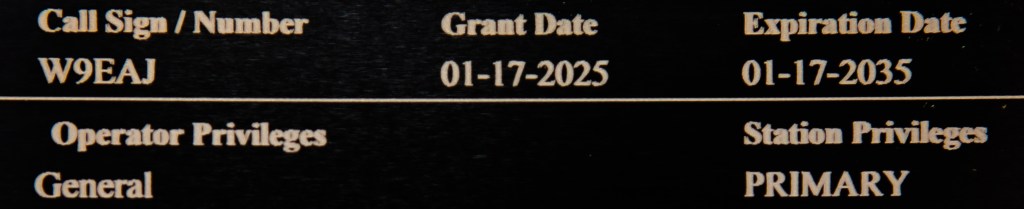
  • New Callsign: W9EAJ

    New Callsign: W9EAJ

    Upon upgrading my amateur radio license to General last month, I begin looking for a vanity callsign to replace my KE9BPH originally issued when I first got my Technician license. I know I hadn’t been at this radio thing very long, but I was continually fumbling when trying to clearly speak the callsign. Difficult to remember, difficult to speak, just didn’t care for it.

    I spent quite a bit of time on RadioQTH – Available Calls but did not find any I liked. Then I read the fine print and learned that just because it doesn’t return as an option does not mean it’s unavailable. If a callsign has never been used, it won’t show up in those results!

    And that’s when I stumbled upon what is now, as of January 17th, 2025, my new callsign – W9EAJ. Easier to remember, easier to say, and quicker for me to identity. Win win.

    73.

  • Ham Radio Observations

    It has now been a few months since my first interaction with ham radio. In that time I’ve: passed the Technician and General tests; purchased and learned how to program a pair of handsets; purchased and programmed a mobile UHF/VHF radio for my truck; added an antenna to the truck; and setup and used a pair of HF radios to get on the 10 meter band, making a dozen or so long distance contacts.

    It’s been fun and full of learning. Here are a few things, in no particular order, which come to mind from my experience thus far:

    • The wide variety of power/connectivty options is frustrating, particularly since there is nowhere local to buy this stuff.
    • Ditto with the numerous coax connections and adapters.
    • I’m terrible at copying callsigns. It’s as if, by default, my brain has a 3 character buffer which, by the end of the callsign I hear, has discarded the beginning. I’ve taken to pencil and paper to write down callsigns calling CQ – it often takes hearing it multiple times, between radio noise and accents, to get it correct.
    • Antennas are confusing, I need to learn more here.
    • I need to figure out a permanent antenna setup, the small vertical in my front yard is less than ideal.
    • NanoVNA is a great learning tool.
    • I’m appreciative of AnyTone products – they’re workable at a great price.
    • I need to get the aforementioned connectors, adapters, jumpers, tools, etc. organized.
    • The local hams are friendly and eager to help.
    • The patchwork of software and systems everyone relies on is reminiscent of early personal computing days, and the BBS scene. I was surprised by this, and it’s a little refreshing.
    • I need to settle on a logging system.
    • I’m still hesitant to key up on the local repeater in response to chatter.
    • Putting names to callsigns takes some time.

    So that’s what comes to mind as I sit here this evening. Maybe I’ll update the list if more things come up.

    Here’s to learning!

  • Ham Radio Nets

    This is more for me to look back on in the future (but what isn’t on the blog, right?).

    I’ve been participating in a couple of the local “nets” put on by the Sangamon Valley Radio Club (http://www.svrc.org) since I got my Technician license last month. One problem I’m constantly having is the 2 meter simplex net.

    I have a pair of super inexpensive Baofeng UV-21R, and a few small antennas for them. They work great (in my mind at least, I have no frame of reference) for 70cm – I’ve been able to hit local repeaters and one that’s a pretty good distance away (40 miles).

    But this 2 meter problem really has me wondering if it’s just the radio. Tonight I went out on my roof with both radios to even _listen_ to the 2 meter net and could not hear a thing. Out of frustration I tossed on a Signal Stick and started walking around the neighborhood. I could hear net control loud and clear in a few spots, and one other participant only very faint.

    I went back inside and, while sitting at the kitchen table, keyed up and threw out my callsign. To my surprise, net control asked me to repeat – he actually heard me while inside my house. I went outside and replied, and was met with dead air again. Walked out front, same thing.

    I walked around the neighborhood again, hearing bursts of chatter but never enough to communicate. So I gave up and went in and waited for the 70cm net which was to happen about a half hour later.

    On that net, I was suprised to hear at least two others mention that they heard me loud and clear a couple of times, but then I’d disappear. Frustrating, but par for the course for these radios and their HT/mobile antennas?

    I have a radio or two on my Christmas list, and am looking out for any Black Friday deals on a mobile VHF/UHF radio I can use as a base station to hopefully rectify this problem. In addition, I just signed up for the ARRL Welcome Kit which includes an HT they’ve partnerered with Gigaparts on. I’m 100% certain it will be a better radio than the Baofengs. It’s supposed to arrive in a couple of days so I’m looking forward to comparing it on the next nets.

    I feel like I’m wasting everyone else’s time with the equivalent of “can you hear me now?”, and I’d like that to end.

  • Ham Radio Technician License

    I was issued my amateur radio Technician license and callsign on 10/22/2024. So, hello from KE9BPH!

    A big shout-out to the remote testing offered by the Tennessee Valley Exam Team (sign up at Hamstudy.org). It operated like a well-oiled machine while being friendly and encouraging. When the time comes to get my General license, I’ll be looking to do so with them.

    Why?

    I’ve been asked a few times now about why, and after giving it some thought, I’ve realized there are four main reasons.

    1. Personal Experiences

    I have had a GMRS license (WRHV579) for several years now. I have a set of radios which my family and I use whever we are going hiking or camping, to facilitate quick contact and give the kids some freedom while still giving us peace of mind.

    These radios have worked fine for our needs. But this this summer we were hiking on some trails in Utah when we came upon a hiker needing legitimate help: they were unable to walk on their own; it was over 100 degrees; and there was no cellular service available. I tried like heck to get ahold of someone with our GMRS radios but was met with dead air. In the end this person did get the assistance they needed, but it left me with a very bad feeling about the whole ordeal – my backup communication was worthless and I didn’t like it.

    2. Travel Communications

    We do a fair bit of traveling, and have often found ourselves in fairly remote, unfamiliar areas without cellular service. We’ve never run into any problems, but the what if is always in the back of my mind.

    3. Emergency Situations

    I’ve often heard of ham radio’s utility when it comes to widespread emergencies, and this was brought to the forefont with the recent hurricane which destroyed many North Carolina communities. I know if my family were in any such situation, getting information in and out would be such an important capabilitiy – and not having that ability, again, makes me nervous.

    4. Curiousity

    In case you cannot tell by some of the other content of this blog, I’m a pretty curious person. I’ve recently come to realization that the best things come when I allow myself to investigate my curiousities and see where they lead and what I can learn. From early computer use in the 1990s, to the internet, to programming, to photography, to woodworking – I learn the most when I follow my curiousity. So here I am with radios.

    How?

    Everyone learns differently. Myself, I learn best progressing from reading books to immersing myself in related content from as many avenus as possible. For example, some heavy reading followed by diving into Youtube videos, podcasts, and blog posts.

    I must say, for the Technician license, this was a little frustring. There are many great resources for studying for the test, but I couldn’t find a definitive reference to learn from; rather, it seemed that most sites just wanted guide you through rote memorization in order to pass the exam. I ended up buying the ARRL study guide, which was sort of what I was looking for, but was still hyper focused on the test itself (for good and bad).

    Don’t get me wrong, this book, combined with the excellent Hamstudy.org, had me passing the test in almost exactly a week of studying. I just don’t feel like I gained much of any underlying understanding of how all of this stuff works, and that bugs me.

    What’s Next?

    Now that I have my license, I have a pair of cheap HTs (Baofeng UV-21R) and a few small antennas to start participating in the local community. There’s such a broad array of topics to learn in the hobby, far more than I ever imagined when I looked at it from the outside. My plan is to ultimately get my General license, but only after I’ve gotten a real fundamental grasp of the underlying principles. To that end, I’ve started reading Radio Theory Handbook – Beginner to Advanced. I’m hoping this gives me what I’m looking for (at 25% through, it is) – a foundation to learn and remember this stuff.

    Then there’s the plethora of new acronyms and terms to gradually pick up from just listening. And of course I have my eyes on a couple of other radios to help me explore in ways HTs don’t allow. Antennas will follow, but I’m not letting myself down that rabbit hole until I get a better gasp on how they actually work. An software, lots of software and tools which get cobbled together like the old days. Good stuff.

    The community I’ve encountered thus far has been welcoming and more than willing to help in any way possible. It’s reminiscient of the comraderie I encountered years ago with fellow BBSers and early computer hobbiests – everyone is just trying to figure out how things behave and what they can get out of these little machines. It’s fun to be back at ground zero, searching for answers in a field in which I have zero experience and knowledge.