David likes to brush his teeth in the morning. Here he is, telling me to leave him alone while he gets ’em clean.

Ramblings of a geek with a few hobbies…
David likes to brush his teeth in the morning. Here he is, telling me to leave him alone while he gets ’em clean.

I started this project on the weekend of January 25th, and here on March 6th my camera cabinet sits completed and filled with my gear. It turned out WAY better than I hoped and expected and I don’t have to hide it in a corner. I normally wouldn’t have gone for the gold hardware, but we wanted it to match the piano that’s in the same room.
It’s made of Red Oak, stained with 2 coats of Minwax Red Oak oil-based stain, and finished with 2 coats of polyurethane.
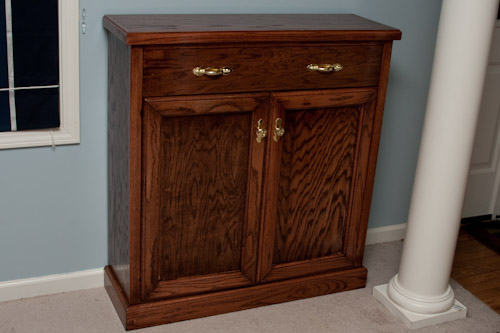
This photo reminds me that I need to get the magnetic door closers.

Here’s the inside – storage for my camera bags on the bottom and lenses on the shelf (all but one lens, which I used to take this).

And the drawer is full of the numerous accessories, plus the camera.
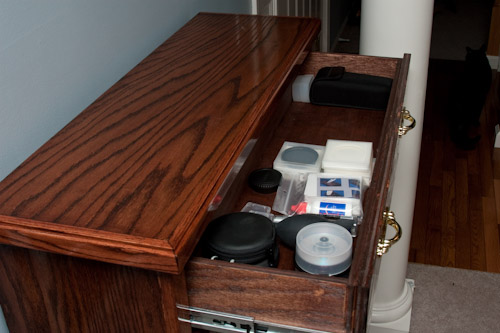

Feels good to finally have it done and to be happy with the results. Photos from the build here. A big thanks to dad for coming over tonight to help me move it upstairs, it’s a little too big for one person.
I did lots of sanding on Thursday night, Friday night, and Saturday morning. And tonight I was able to apply the first coat of stain.


So far I’m fairly pleased with the results. I can see a few spots where I screwed up and must not have sanded all of the wood glue remnants, the jury is out on whether or not I’m going to do anything about the blatant ones. So I guess I should say it looks pretty good, and looks fantastic if I squint 😉
I’ll let this dry over night, hopefully it’ll be ready for another application in the morning.
Update: Here’s what it looks like Sunday night, after 2 coats of stain.
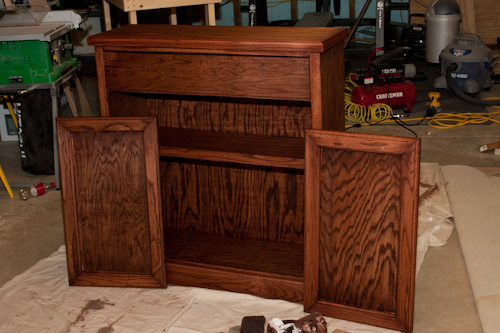

This evening I finished the remaining work on the cabinet construction.

Here’s a photo of how my camera bags fit – not too shabby. The lenses will go on the shelf and the camera in the drawer with all of other accessories.

While I’m glad to have it all completely built finally, I’m pretty nervous about staining it. I’ve never stained anything before, and I’d really hate to ruin this thing.
8 Hours. That’s how long the project book said it would take to make the book case I designed my camera cabinet off of. Ha! I can’t even count how many hours I’ve put in on this thing now – probably another 6 or so this weekend. I’m slow.
I made quite a bit of progress in the past couple days: top trim; adjustable shelf; researched, bought hinges; made and hanged(?) the doors; and got almost halfway done making the trim for the doors. I also picked out a couple sample stains and tried them out on some of the scrap wood. I think I’ll be going with a couple coats of Minwax Red Oak over the Red Mahogany, but we’ll see.
Here’s where it stands tonight (more photos here)..


Bits left: finish making and installing door trim; make the back; sand; stain; poly.
Recently David has been trying to sit on anything that’s at his level. It’s pretty funny to see him back into and sit on a diaper bag, pillows, or any toy that he thinks could provide a place of rest. We looked around a few stores for a suitable chair, and ended up with this Cars one from Toys R Us.

As you can see, he’s pretty excited about it 🙂 More photos in the gallery.
It has been a very productive weekend, and as I sit here on Sunday night I’m beat.
First, we emptied David’s toy box and took it out to the garage so it could get it’s first couple coats of paint. It looks great already, and Ana still has lots of details planned for it remaining. Here it is, back in our family room and in use.

I also spent a few hours here and there getting some more work done on the camera cabinet I’m building. I’ve gotta admit, this is the best project I’ve done so far and I’m really excited to get it done, stained, and filled with my camera equipment.
Here’s the basic case, the top is going to be a long drawer (36 inches) and the bottom is going to be a pair of doors hiding an adjustable shelf. The plan is to put my camera bags on the bottom, lenses on the adjustable shelf, and camera and accessories in the drawer.

Here’s some detail of the routed and mitered trim base.

And here’s the drawer (minus the face) bottom.

So all that’s remaining is: route and attach trim for the top; mount the drawer and attach the drawer face; make and attach the front doors; attach the back; sand and stain a dark cherry color to match our piano. So far so good!
I recently installed FogBugz 6 on 64-bit Windows Small Business Server 2008, and boy was it interesting. I’ll first note that I’ve had excellent installations and upgrades of FogBugz in the past, so this really caught me off guard and took a while to figure out what was going wrong.
Second, after finding out what the problems were, it’s clear that this applies to far more than just FogBugz. It all boils down to 32-bit web apps running on the 64 bit platform, and the fact that it’s Small Business Server which has TONS of software preconfigured and running on it.
The first problem I ran into was the app-pool crashing with an error in the event log saying:
The Module DLL C:Windowssystem32RpcProxyRpcProxy.dll failed to load.
Some googling around resulted in learning that RPC over HTTP (a feature used by Outlook Anywhere in Exchange, which is a big part of SBS) is known to break 32-bit worker processes. One quick solution is to just uninstall the RPC over HTTP Windows feature, and that’s what I did just for speed.
The other fix is to edit applicationhost.config and add preCondition=”bitness64″ for the rpcproxy.dll modules and globalModules entries. I’ll probably go back and make this change since I’m going to want to use RPC over HTTP.
Anway, I kept getting HTP 500 (500.19 this time) errors when loading the app. Further investigation revealed that Windows Server Update Services (WSUS), also packaged in Small Business Server, installs a compression module in IIS 7 that, you guessed it, breaks 32 bit app pools. From the IIS forums, to disable the compression scheme:
%windir%system32inetsrvappcmd.exe set config -section:system.webServer/httpCompression /-[name=’xpress’]
And, to re-enable if you need:
%windir%system32inetsrvappcmd.exe set config -section:system.webServer/httpCompression /+[name=’xpress’,doStaticCompression=’false’,dll=’%windir%system32inetsrvsuscomp.dll’]
And there you have it, after doing those things you can run 32 bit app pools. As a side-note, I recall that disabling FogBugz’s custom error page was a tremendous help in seeing what was really going on.
I have very mixed feelings about Small Business Server. On one hand, there’s so much software configured and running and they all are configured just so to allow them to work. What’s worse, you really can’t/shouldn’t fight the topology and layout of things that are in place. If you do, things break and break in very bad ways. And since there’s so much software installed already, it’s hard to know the side effects of everything. But on the other hand, it’s thousands and thousands of dollars of software for a fraction of the price.
Aaand finally, if you’re buying a Small Business Server, be sure to get more than 4GB of RAM. You’ll need it.
It warmed up a bit here today but, since our house provides shade for our front yard in the winter, there was plenty of snow around for David to play in today. Well, he didn’t really play as much as break down and cry once we set him in it.